Cars & Driving

How 250 kg of nitrogen lifts a car: the Roadster thruster math

Our own physics estimate, updated with Tesla's new numbers: at 80 kN, the Rocket's 250 kg of nitrogen lasts about 2 seconds, and the Thrust's tank about 5. Every step and assumption, shown.

Oct 16, 2026 · Updated Nov 1, 2026 · 10 min read

By our estimate, the 250 kg of gas in the flying Rocket version can push the new Tesla Roadster at full thrust for only about two seconds. That is enough for a launch, a hop of a few stories, or a flip with a soft landing, but not for real flight. These are our own calculations, not Tesla's, and every assumption is listed below so you can check them.

This page was first built on the numbers Tesla gave at the October 15 show. Since then, Tesla's vehicle engineering chief Lars Moravy has given interviews with new figures: the car's weight, the size of each tank, the gas inside, and how long the boost lasts (Tesla North, Electrek). We redid every result with them.

How a cold-gas thruster works

Picture a blown-up balloon you let go of, made far stronger. Or picture sitting on a skateboard and spraying a fire extinguisher backward: the spray goes one way and you roll the other. Gas squeezed very tight in a tank rushes out of a nozzle, and the car is pushed the opposite way. Nothing burns. SpaceX uses this kind of thruster to steer its rockets (TechCrunch).

The push depends on two things: how many kilograms of gas leave each second, and how fast they leave. Multiply the two and you get the force:

Force (newtons) = gas used per second (kg/s) × exhaust speed (m/s)

A newton is a unit of force. One kilonewton (kN) is 1,000 newtons, about the weight of a 100 kg object here on Earth.

Air or nitrogen?

Tesla's engineer says the tanks hold nitrogen. "Nitrogen seemed like a good fuel," Moravy told Hagerty (Tesla North). Some outlets still call it compressed air (Fortune). For the math it barely matters: the air around you is already about 78% nitrogen, and the two gases behave almost the same in a nozzle. We use nitrogen from here on.

Think of the tank as a scuba tank, only far stronger, and filled from a big outside supply rather than a pump in the car (more on that below).

What Tesla told us, and what we had to assume

Input Value we used Where it comes from
Gas in the Rocket 250 kg Reported by Paultan and CarBuzz from Lars Moravy. Two outlets say 260 kg (Investing.com).
Tank sizes Thrust: one 200-liter tank. Rocket: that plus a 400-liter tank where the passenger seat would be, 600 liters in all Moravy to Hagerty (Tesla North, Electrek)
Gas Nitrogen Moravy (Tesla North)
Rated pressure Up to 10,000 psi Moravy to Hagerty (Tesla North). A gauge on the car's screen reads "Thruster · 5,500 PSI" in Tesla's own interface video (Tesla North), first spotted in a photo by EVXL.
Rear thrust 80 kN Tesla claim of "over 80 kilonewtons" (Paultan, Jalopnik)
How long the Thrust's boost lasts About 5 seconds per fill Moravy to Top Gear, via Torque News and AutoGuide
Car mass 1,700 kg (about 3,700 lb) Moravy: "just under 1,700 kilos," final numbers still to come (Tesla North). We used 2,000 kg before he said this.
Exhaust speed 600 m/s (range 500 to 700) Our estimate. See below.

Why 600 m/s? We worked out the top speed room-temperature nitrogen can reach when it expands from a tank into a vacuum. Using the standard formula for an ideal nozzle, that ceiling is about 780 m/s. A real nozzle at sea level gets less, and the gas chills as the tank empties, which slows it further. Wikipedia's reference table lists a measured cold-gas figure for nitrogen that works out to about 716 m/s in a vacuum (Wikipedia: cold gas thruster). We use 600 m/s as a middle value and show 500 and 700 m/s as low and high cases.

Result 1: full thrust lasts about two seconds (Rocket)

To make 80,000 newtons at 600 m/s, the nozzles must release:

80,000 ÷ 600 = about 133 kg of gas per second

With 250 kg on board:

250 ÷ 133 = about 1.9 seconds

At 500 m/s the answer is about 1.6 seconds. At 700 m/s it is about 2.2 seconds. Either way, flat-out thrust ends in around two seconds.

Result 2: the Thrust version's 5 seconds

The Thrust version has only the 200-liter tank. If it is packed as tightly as the Rocket's, that is about 83 kg of nitrogen (one third of 250 kg).

  • At a full 80 kN, 83 kg would be gone in about 0.6 seconds.
  • Spread over Moravy's 5 seconds, the average push is only about 10 kN, or 0.6 g on a 1,700 kg car.

So the 80 kN can't last. Our reading: the thrusters hit hard at the start, then fade. A tank loses pressure as it empties, and thrust drops with it (Wikipedia: cold gas thruster). The 0-60 numbers support this. Tesla's 0.85-second Thrust run needs about 32 kN from the thrusters on top of the tires, which uses about 46 kg, more than half the tank, in under a second. The rest trickles out over the next few seconds, the "first two-thirds of that quarter-mile run," as Moravy put it (Torque News). Tesla hasn't published a thrust curve, so this is our interpretation.

Result 3: a hover would last single-digit seconds

Holding a car still in the air takes less force than a full-power launch. You only need to match its weight.

  • Weight of a 1,700 kg car: 1,700 × 9.81 = about 16,700 newtons (16.7 kN)
  • Total push stored in the Rocket's tanks: 250 kg × 600 m/s = 150,000 newton-seconds
  • Longest possible hover: 150,000 ÷ 16,700 = about 9 seconds

The range is 7.5 to 10.5 seconds, depending on exhaust speed. The car gets a little lighter as gas leaves, which helps a bit. Several things cut the time down more: thrust drops as tank pressure falls, some gas goes to steering, and gas must be saved for landing. A real hover would be shorter than this ceiling. Tesla has not given any flight time (Investing.com).
Result 4: how high one hop could go

This one needs an extra assumption. The 80 kN figure is for the rear thrusters. Tesla has not said exactly how hard the four downward-facing corner nozzles push. For this example, we assume they could match 80 kN together. Tesla's Lars Moravy backs that up. On X on October 21 he wrote that the system "can produce over 80kN of force," and that even if the car weighed "a ridiculously high 2500 kg," counting the gas and thruster parts, "the lift from the thrusters is >3x the mass of the vehicle" (Drive Tesla, Tesla North). That is Tesla's claim. Our check: holding up 2,500 kg takes about 24.5 kN, and 80 kN is about 3.3 times that, so his numbers agree with each other.

Fire straight down for half a second:

  • Upward push minus weight: 80,000 − 16,700 = 63,300 N
  • Upward acceleration: 63,300 ÷ 1,700 = about 37 m/s², or about 3.8 g
  • Speed after 0.5 s: about 18.6 m/s
  • Height gained during the burn: about 4.7 m
  • Extra height while coasting up: 18.6² ÷ (2 × 9.81) = about 17.7 m
  • Total: about 22 m, or 73 feet, using about 67 kg of gas

Coming back down from 22 m, the car would hit about 21 m/s (47 mph). Braking that with the same thrust takes about 0.56 seconds and roughly 75 kg more gas. So one 22 m hop with a soft landing uses about 142 kg, more than half the tank.

For comparison, Paultan estimated the kickflip peaked at about 7 meters (Paultan), and NBC reports Tesla put the second jump at 27 feet, about 8 meters (NBC). That fits well inside what the gas could do, especially since the car launched off a ramp.

Result 5: the fall off the upside-down ramp

Paultan put the top of the ramp at about 21 m and reported the thrusters braked the fall at up to 3.3 g (Paultan).

If the car fell the full 21 m, it would reach about 20 m/s (45 mph). Our numbers give a braking rate of about 3.8 g from 80 kN on a 1,700 kg car. At that rate, stopping takes about 0.55 seconds, about 5.5 m of height, and about 73 kg of gas. Paultan's 3.3 g is a little gentler than our 3.8 g, which fits a car using a bit less than full thrust.

Result 6: the 0-60 claims

Sixty mph is 26.8 m/s.

  • Thrust alone: 80,000 ÷ 1,700 = 47 m/s², about 4.8 g. That reaches 60 mph in about 0.57 seconds.
  • Add tire grip of about 1.26 g, a figure from Lars Moravy (Paultan), and the total is about 59 m/s². That reaches 60 mph in about 0.45 seconds.

So the Rocket's claimed 0.55 seconds, measured with a one-foot rollout, is possible on paper (Tesla North). The car's lighter weight makes the claims easier to believe than our first version of this page showed.

The "4–5x the tires" claim now fits better. Tesla says the thrusters make "4–5x the force the tires can" (Fox Business). Tires gripping at 1.26 g on a 1,700 kg car push with about 21 kN. 80 kN is about 3.8 times that, close to Tesla's ratio, and Tesla said "over 80."

Result 7: how hard is the gas squeezed?

250 kg of nitrogen in 600 liters is about 417 kg per cubic meter. Ordinary air weighs about 1.2 kg per cubic meter. So the tanks hold gas about 350 times denser than the air around you.

At these pressures gas doesn't follow the simple school formula, so we used published real-gas data for nitrogen at room temperature. That density needs about 490 bar, roughly 7,100 psi. A car tire holds about 2 bar. That sits between the 5,500 psi on Tesla's screen gauge and the 10,000 psi rating Moravy gave, which is what you'd expect from a tank that isn't filled to its limit. This is our estimate.

Result 8: refilling takes hours, from outside the car

At the show Musk said, "The car can recharge its air tank" (Paultan). Moravy has since been specific. The tanks are filled from an outside high-pressure nitrogen system, not a pump in the car. "Current fill times are two to six hours" for the Thrust's 200 liters, and filling all 600 liters is reported at 6 to 7 hours. Tesla hopes to get it "under a half hour" (Torque News, Tesla North). Hagerty's Henry Catchpole put it simply: "Refilling the nitrogen tanks isn't something you'll be doing at home" (via Torque News).

How much energy does that take? Squeezing 250 kg of nitrogen to about 490 bar needs at least about 38 kWh, even in a perfect compressor. The Thrust's 83 kg needs at least about 13 kWh. Real compressors waste much of their energy as heat, so a real fill takes more. MotorTrend reports the battery is "substantially more than 100 kWh" (MotorTrend). That is one reason a fill station makes more sense than draining the car's battery.

What the math tells us

  • It is a jump jet, not a plane. Seconds of thrust, a few stories of height, then wheels down.
  • Tesla's stunts fit the physics. With the real weight of about 1,700 kg, the heights and braking forces reported at the show are comfortably within what 250 kg of nitrogen can do.
  • The thrust fades fast. A big kick for the first second, then a tail. That matches Moravy's "about five seconds" for the Thrust.
  • Using the thrusters is a planned event. Hours to refill, at a fill station, means a few seconds of fun per visit, for now.

Squeezing gas is expensive. Cooling with air can be nearly free. On many summer nights the air outside is cooler than the air inside. Our sister app, Cool Cue, made by the same small company as this site, tells you when outside air is cooler than inside, so you can open the windows at night and close them in the morning.

Sources

How this was made: researched and written with the help of AI, then fact-checked and approved by a person before publishing. Every fact links to its source. This story first ran on roadsterflies.com, another site from the same family. Spot a mistake? Tell us.

Keep reading

Cars & Driving

Forget the flying. The Roadster's biggest secret is the motor and battery you can't see.

Two small motors that out-muscle a Plaid, a battery that fills in about 10 minutes, and parts borrowed from a robot and a rocket company. Here's the new tech, in plain words.

Cars & Driving

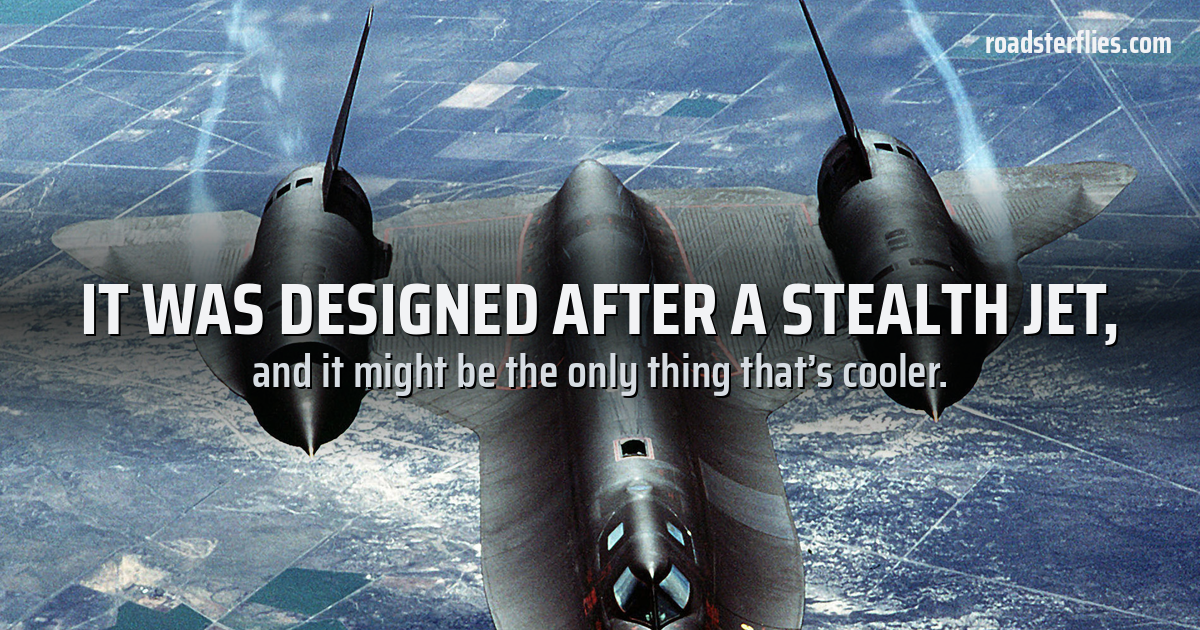
It was designed after a stealth jet, and it might be the only thing that's cooler.

It takes its looks from the SR-71 Blackbird and the F-35 stealth fighter. Then it does something neither jet can do.

Cars & Driving

Tesla Roadster price: what we know, what it costs to reserve, and what happens to 2017 buyers

Tesla has not priced the new Roadster. Reserving costs $50,000 or $250,000 by version, and Tesla's terms say it can't guarantee delivery. How it works, and what 2017 buyers still don't know.